


A Practical Guide to TPO Roofing
Why a TPO Roof Is a Smart Flat-Roof Option
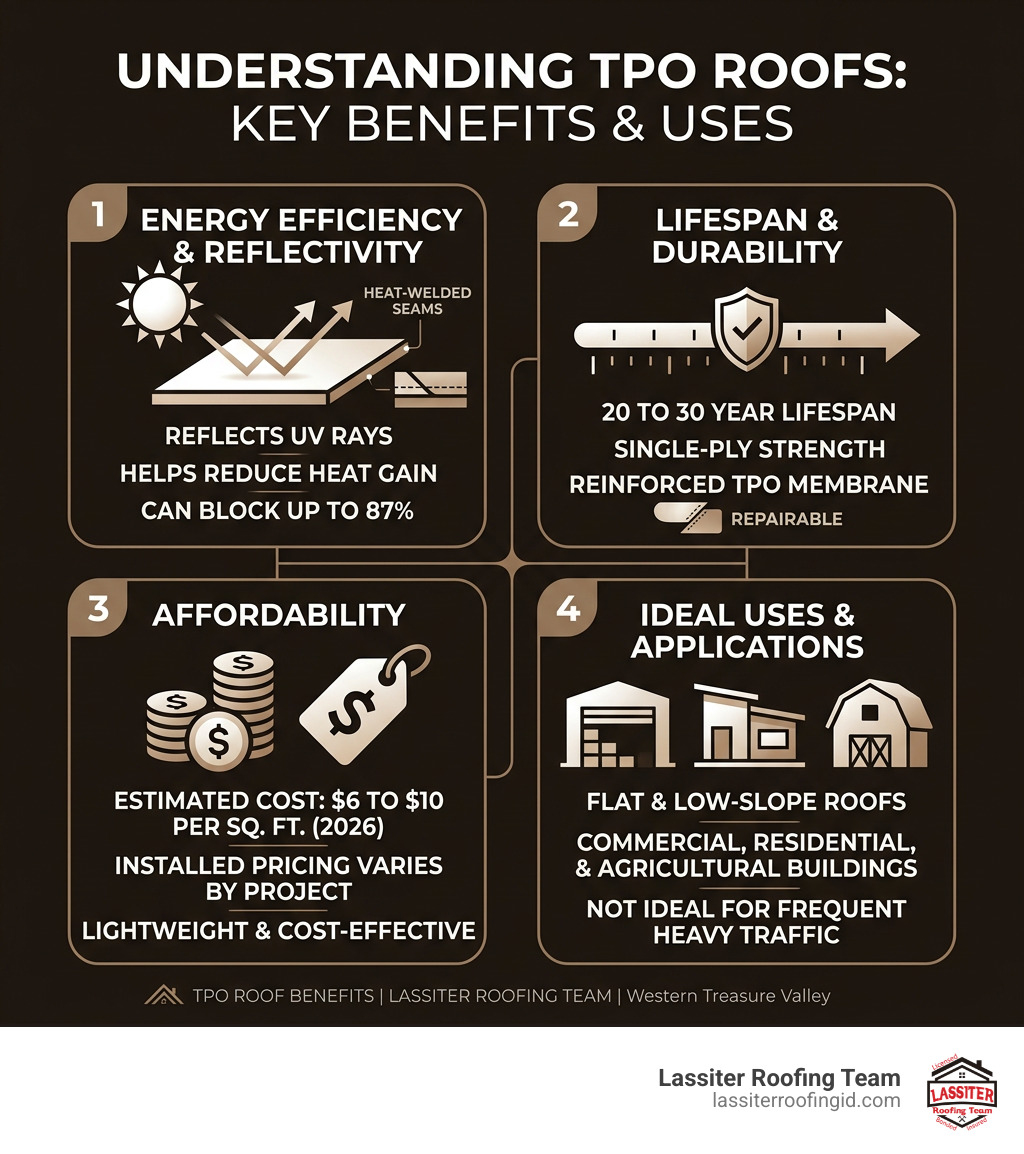
A TPO roof is a lightweight, single-ply roofing system made for flat and low-slope roofs. Its bright, reflective surface helps limit heat and UV exposure, while heat-welded seams help create a strong water barrier. With proper installation and upkeep, most TPO roofs last about 20 to 30 years.
TPO is especially worth considering when you want a roof that is:
Energy efficient: White TPO can block up to 87% of UV rays, helping reduce heat gain in sunny climates.
Affordable: Installed pricing often falls around $6 to $10 per square foot in 2026, though roof access, insulation, tear-off, and repairs can change the final cost.
Lightweight: It places less weight on the structure than traditional built-up roofing (BUR).
Repairable: Qualified roofers can heat-weld patches over many punctures or seam issues.
Suitable for reroofing: In some cases, TPO can be installed over a sound existing low-slope roof, avoiding a full tear-off.
For roofs with frequent maintenance traffic, heavy equipment, or harsh physical wear, a multi-layer BUR system may offer more built-in protection. The right choice depends on drainage, roof use, weather exposure, insulation needs, and the warranty offered by the manufacturer and installer.
I am Kason Walton, owner of Lassiter Roofing Team, with more than 30 years of roofing experience across residential, commercial, and agricultural properties in Idaho's Western Treasure Valley. Our work with TPO roof systems helps property owners weigh cost, weather protection, installation details, and long-term warranty coverage before they commit.
Understanding TPO Roof Systems and Material Composition
Thermoplastic Polyolefin (TPO) is a synthetic, single-ply roofing membrane engineered specifically for flat and low-slope roof applications. Developed by blending ethylene-propylene rubber with polypropylene polymer bases, TPO provides the durability and weather resistance of rubber alongside the heat-weldable flexibility of plastic. Inside the membrane, a strong polyester reinforcing fabric scrim is encapsulated between the top and bottom plies, giving the sheet remarkable tearing and breaking strength.
Over the past two decades, TPO has expanded rapidly to command roughly 40% of the entire commercial roofing market share. Building owners and specifiers favor it because it delivers modern polymer performance without requiring added plasticizers, which can leach out over time and cause premature brittleness in other materials.
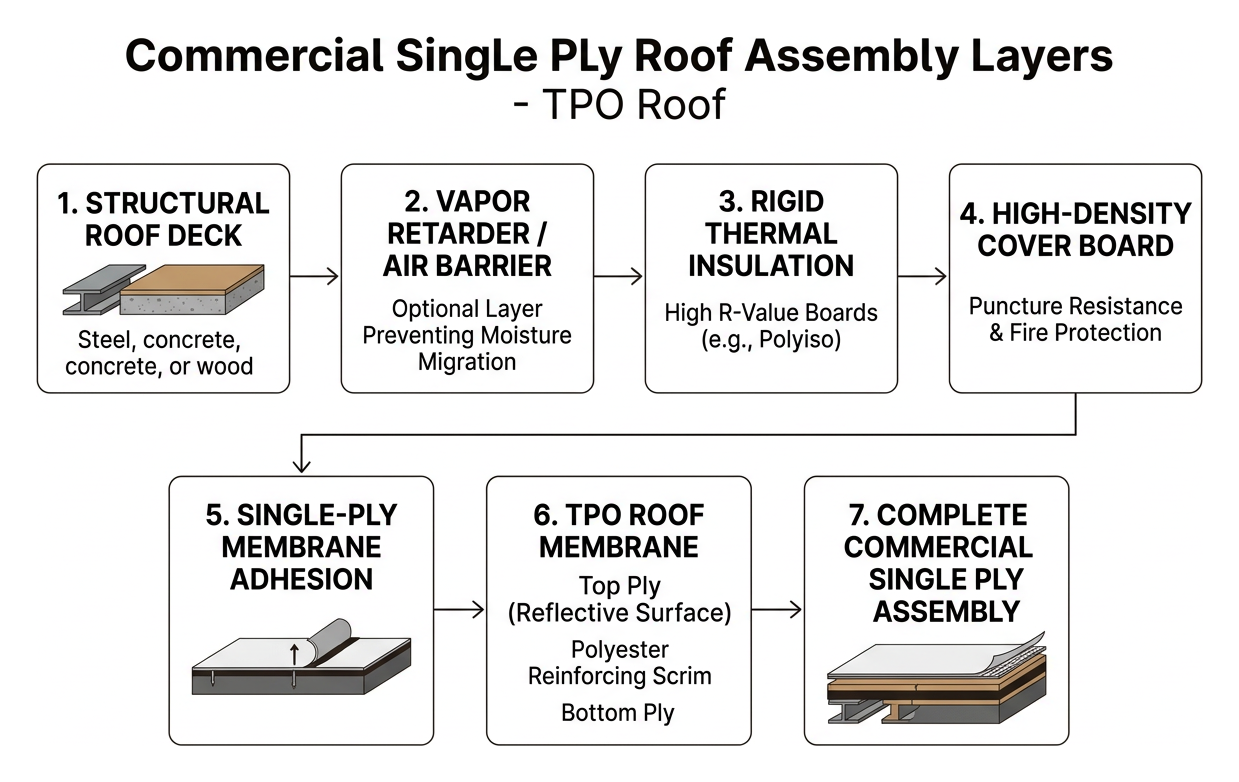
A complete assembly consists of several components working in harmony:
Structural Roof Deck: Steel, concrete, or wood.
Vapor Retarder / Air Barrier: Optional layer preventing moisture migration from inside the building.
Rigid Thermal Insulation: High R-value boards, typically polyisocyanurate (polyiso).
High-Density Cover Board: Adds puncture resistance and fire protection.
TPO Single-Ply Membrane: The water-shedding, UV-reflective outer layer.
When designing or installing these systems, following established commercial single-ply installation guidelines ensures that attachment patterns, lap dimensions, and welding protocols meet stringent building codes and wind uplift requirements.
Key Advantages of a Modern TPO Roof
TPO roofing systems deliver several distinct mechanical and practical benefits:
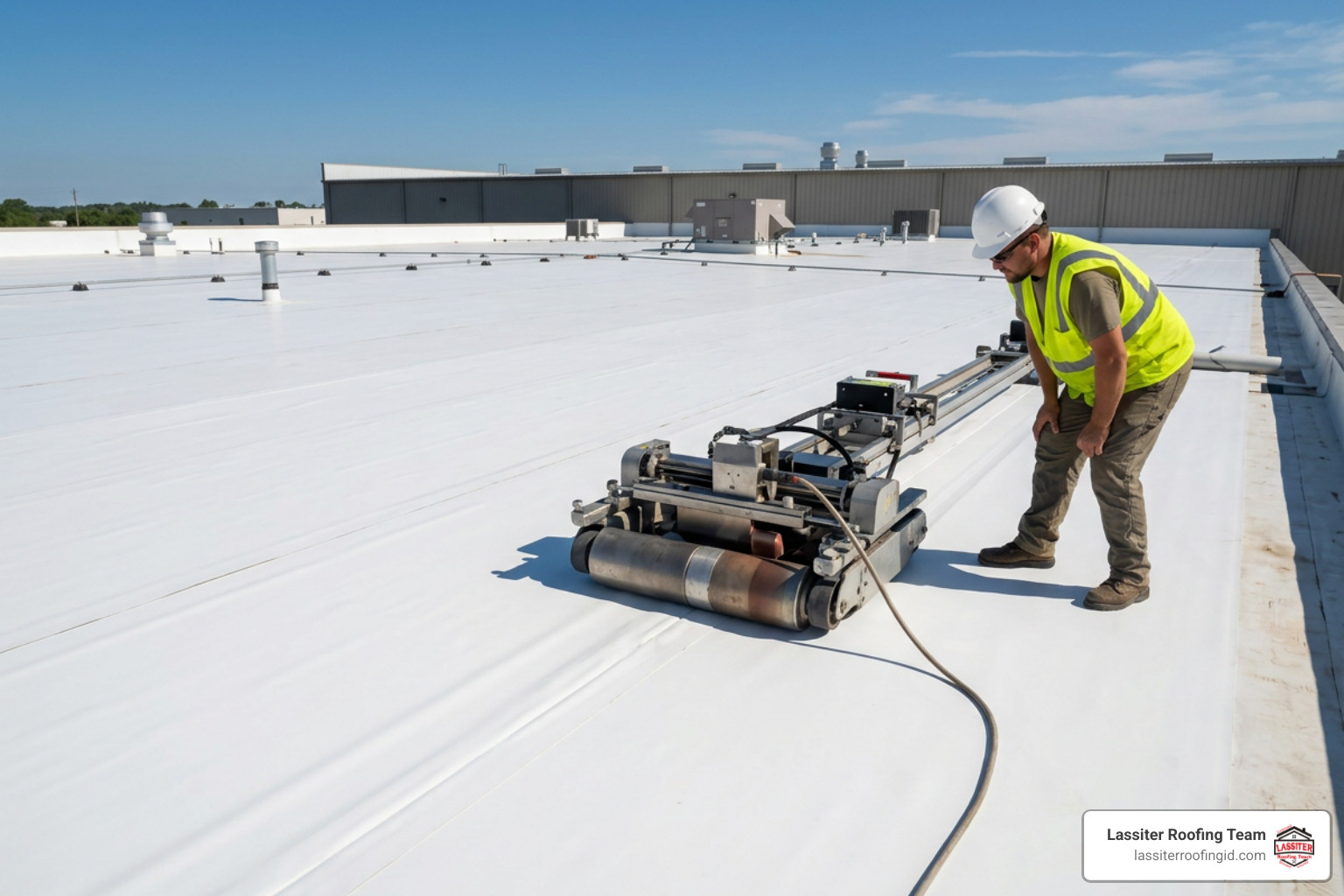
Monolithic Heat-Welded Seams: Rather than relying on glues, tapes, or solvent adhesives that degrade with age, installers use hot-air welders to fuse overlapping sheets together. The resulting seam is physically stronger than the membrane itself.
Chemical and Mold Resistance: The polymer formulation naturally resists bacterial growth, mold, algae, and industrial chemical exposures such as acids and animal fats.
Puncture and Tear Resistance: Tested according to rigorous ASTM membrane testing standards, TPO exhibits superior puncture resistance (exceeding standard requirements of 265 lbf) to protect against dropped tools, hail, and flying debris.
Cold-Weather Flexibility: Because the material contains no chemical plasticizers, it remains pliable and impact-resistant during freeze-thaw cycles and sub-zero winter temperatures.
Energy Efficiency and UV Reflectivity
One of TPO's greatest strengths is its solar reflectance. High-performance white membranes can block and reflect up to 87% of incoming UV rays, carrying initial Solar Reflectance Index (SRI) values as high as 94 to 99.
In sunny environments, this exceptional reflectivity keeps rooftop surface temperatures dramatically cooler than dark asphalt or unmodified rubber membranes. In turn, cooling equipment runs more efficiently, lowering interior utility costs while helping mitigate urban heat island effects. For building owners in the Pacific Northwest and Intermountain West seeking lower operational overhead, scheduling a professional TPO flat roof installation can provide immediate thermal relief and steady energy savings.
TPO vs. Traditional Flat Roofing Systems: Key Differences
When choosing between single-ply TPO and traditional multi-ply systems like Built-Up Roofing (BUR), it helps to evaluate how each performs across fundamental building criteria.
Feature / Metric | Modern TPO Single-Ply | Traditional Built-Up Roofing (BUR) |
|---|---|---|
Material Composition | Thermoplastic polyolefin polymer with polyester scrim reinforcement | Multiple alternating layers of bitumen (asphalt/coal tar) and reinforcing fabrics |
Installed Weight | 0.3 to 0.8 lbs per square foot (very lightweight) | 2.5 to 6.0+ lbs per square foot (heavy dead load) |
Typical Lifespan | 20 to 30 years | 20 to 30 years |
Seam Technology | Hot-air fused monolithic welds | Layered bitumen overlap with gravel or mineral cap sheet |
Solar Reflectance | Up to 87% UV reflectivity (High SRI) | Low to moderate (unless specialized reflective coatings are applied) |
Foot Traffic Resistance | Moderate (requires walk pads in designated areas) | Very high (gravel cap sheet provides natural protection) |
Installation Speed | Fast; wide rolls (up to 12 ft) cover large areas quickly | Slower; multi-step layering requiring kettles or cold adhesives |
Average Installed Cost (2026) | $6.00 – $10.00 / sq. ft. | $7.00 – $12.50+ / sq. ft. |
Durability and Traffic Resistance
Multi-ply BUR systems offer built-in physical redundancy: if the surface layer suffers a small scrape, multiple underlying plies continue keeping water out. The heavy gravel ballast used on traditional BUR roofs also offers natural protection against mechanical damage and heavy foot traffic.
TPO provides incredible tensile strength, but because it is a single-ply system, a puncture through the sheet reaches the underlying insulation board. On buildings where technicians regularly service rooftop HVAC units, chillers, or communications equipment, we install heavy-duty, textured TPO walkway pads around service panels and high-traffic pathways to ensure the membrane remains protected against dropped tools and sharp boot treads.
Maintenance and Expected Lifespan
Both TPO and BUR offer service lives ranging from 20 to 30 years when properly maintained. However, the ongoing maintenance requirements differ substantially.
BUR can develop soft spots, gravel displacement, or hidden moisture pockets within its plies, which can be challenging to pinpoint. In contrast, TPO creates a clean, visible field that makes routine inspections straightforward. If an unexpected leak occurs, working with certified professionals who specialize in flat roof repair ensures that any puncture or flashing damage is resolved correctly. Technicians clean the damaged area and use specialized hot-air hand welders to fuse a permanent TPO patch directly over the defect—restoring the monolithic barrier without mess or temporary mastic sealants.
Installation Methods and Retrofit Options
TPO membranes can be installed using several primary engineering methods, chosen based on building geometry, deck type, and wind exposure:
Mechanically Attached Systems: Fasteners and stress plates are driven through the insulation into the structural deck along the membrane edges before overlapping seams are hot-air welded. This is typically the most economical and common commercial approach.
Fully Adhered Systems: The membrane is bonded continuously to approved substrate boards using water-based, solvent-based, or low-VOC adhesives. Adhered installations provide superior wind-uplift resistance and an ultra-smooth visual finish, as outlined in technical fully adhered membrane specifications.
Ballasted Systems: Membrane sheets are laid loosely over the insulation and held down with round river rock or concrete pavers (minimum 1,000 lbs per roof square). While fast to lay, the building must be engineered to support significant dead-weight loads.
Can You Install a TPO Roof Over an Existing System?
Yes, TPO is an ideal material for roof recover (retrofit) applications. If an existing low-slope roof is structurally sound and free from trapped moisture, a new TPO assembly can often be installed directly over it.
Using specialized fleece-back TPO—which incorporates an underside polyester fleece mat—allows contractors to adhere the new sheet over rough substrates, old modified bitumen, or smooth BUR. Retrofitting eliminates the disruption, labor costs, and dumpster fees associated with a full tear-off. However, local building codes generally limit roofs to two total layers, and core moisture scans must always verify that the underlying deck is completely dry before overlaying.
Seam Welding and Flashing Details
The integrity of a single-ply system rests upon its seams and penetrations:
Automatic Hot-Air Welding: Robotic welders travel along field laps at controlled temperatures (between 800°F and 1,100°F depending on ambient weather and speed), fusing a continuous weld with a minimum width of 1.5 inches.
Mechanical Probe Testing: After the seam cools, technicians run a blunt metal cotter pin or probe tool along every inch of the weld edge to verify that no voids or cold welds exist.
Flashing & Terminations: Pipe penetrations, drains, and HVAC curbs are sealed using pre-molded boots or hand-welded non-reinforced flashing membranes. Perimeter parapets are wrapped and secured beneath heavy-gauge metal counterflashings and termination bars.
Costs and Thickness Considerations for 2026
When budgeting for a commercial or residential flat roof project in 2026, working with flat roof contractors in your area who understand localized building codes will ensure accurate pricing and proper material selection.
Material and Labor Price Benchmarks
For standard low-slope installations, the TPO membrane itself represents a modest raw material cost—often starting around $0.50 per square foot for base rolls. However, a complete, warrantable commercial roofing assembly includes rigid insulation, fasteners, adhesives, flashing accessories, perimeter metals, and professional labor.
In 2026, total installed project costs generally range between $6.00 and $10.00 per square foot (or $600 to $1,000 per roofing square). Factors influencing the final estimate include:
Substrate Preparation & Tear-Off: Removing old asphalt layers and hauling debris adds labor.
Insulation Thickness (R-Value): Achieving required energy ratings (like R-30 or R-38) requires thicker, multi-layer polyiso boards.
Deck Access & Complexity: Multi-story buildings, tight urban footprints, or roofs with hundreds of mechanical pipe penetrations require additional setup and hand detailing.
Selecting Membrane Mil Thickness and Insulation
TPO membranes are manufactured in three standard nominal thicknesses:
45 Mil (0.045 inches / 1.14 mm): The entry-level standard. Suitable for budget-conscious projects, low-traffic areas, or light residential add-ons. Typical manufacturer warranties range from 15 to 20 years.
60 Mil (0.060 inches / 1.52 mm): The commercial industry workhorse. Provides increased Thickness Over Scrim, offering better puncture resistance, longer UV weathering life, and warranty coverage up to 20 or 25 years.
80 Mil (0.080 inches / 2.03 mm): The ultimate heavy-duty single-ply option. Recommended for facilities in severe hail zones, roofs with regular foot traffic, or projects requiring 30-year maximum protection guarantees.
Pairing the right membrane thickness with suitable rigid insulation—such as high-efficiency polyisocyanurate (polyiso), moisture-resistant extruded polystyrene (XPS), or value-driven expanded polystyrene (EPS)—ensures optimal building envelope performance and long-term utility savings.
Frequently Asked Questions
How long does a single-ply membrane system last compared to traditional asphalt?
A properly installed and maintained TPO single-ply system has a lifespan of 20 to 30 years, comparable to a multi-ply built-up asphalt roof. While BUR relies on sheer physical mass and redundant layers to resist degradation, TPO achieves its longevity through polymer chemistry, UV resistance, and flexible heat-welded seams that do not dry out or crack over time.
Can single-ply roofing be installed on residential homes?
Yes. Single-ply TPO is widely used on residential low-slope applications, including modern architectural flat roofs, detached garages, covered patios, and home additions. Its clean aesthetic, lightweight footprint, and energy-saving reflectivity make it an excellent alternative to messy rolled asphalt or torch-down products on homes.
What warranties are available for commercial thermoplastic systems?
Commercial systems typically carry manufacturer material warranties ranging from 15 to 30 years, depending directly on membrane thickness (45, 60, or 80 mil) and attachment method. Leading manufacturers also offer comprehensive "No Dollar Limit" (NDL) warranties that cover both labor and materials for qualified commercial assemblies installed by certified applicators.
Conclusion
Choosing the right roofing system is one of the most critical investments a property owner can make. TPO single-ply roofing delivers a winning combination of solar reflectivity, lightweight versatility, watertight seam strength, and competitive project costs. Whether you are constructing a new facility, recovering an existing low-slope building, or seeking long-term utility reductions, a modern thermoplastic system provides dependable protection for decades.
At Lassiter Roofing, we bring over 30 years of hands-on expertise to every residential, commercial, and agricultural project across Idaho's Western Treasure Valley. We provide clear, individually quoted competitive pricing and stand behind our work with our dedicated 5-year workmanship warranty. If you are ready to evaluate your low-slope options, contact the team at Lassiter Roofing to schedule an expert on-site inspection and personalized project estimate.


